

Customer satisfaction defines the degree to which consumer expectations are met or exceeded during interaction with a brand. This aspect is fundamental to building lasting relationships, ensuring loyalty, and driving sustainable business growth.
Many companies focus exclusively on financial metrics to measure success. However, this view is incomplete and dangerous. It is consumers who keep a business running. That is why measuring customer satisfaction is as critical as tracking revenue and profit.
This analysis provides clarity on the strengths and opportunities for improvement in your strategy. With concrete data in hand, you can correct flaws, enhance the customer experience, and build real loyalty.
To assess satisfaction correctly, you need to master specific methods, accurate indicators, and performance metrics that reflect reality. With that in mind, in this article, we will show you how to measure customer satisfaction and how to improve it. Check it out!
What are customer satisfaction metrics?
Customer satisfaction indicators, also known as service KPIs, are markers that allow you to objectively measure the level of satisfaction with the experiences offered. With these indicators, you can get a clear, data-driven view of how customers perceive the service they receive.
This data reveals how much the customer service sector impacts the overall success of the business and helps identify areas for improvement. Quality customer service is essential not only for the functioning of the company, but is also a critical component of the consumer experience.
The quality of customer service directly influences future customer spending, how they recommend your brand to others, and their level of loyalty. These factors, individually, impact profitability.
According to CX Trends 2025, 78% of customers prefer brands that offer a good customer service experience. More than three-quarters of consumers say they recommend the company when the experience is positive.
However, when an experience is negative, 51% of customers have publicly criticized brands.
Closely monitoring these customer satisfaction indicators allows you to know the level of satisfaction with your brand and service, ensuring sustainable profitability and competitiveness in the market.
Why is it important to measure customer satisfaction?
Customer satisfaction is a fundamental step for the results and sustainable success of any business. Understanding this importance is essential for structuring operations and making assertive decisions.
Loyalty and retention are direct consequences of satisfied customers. They tend to make new purchases, significantly reducing your acquisition cost and increasing Lifetime Value (LTV), the value generated throughout the relationship with the brand.
Reputation and advocacy grow when satisfied consumers promote your company through referrals, positive reviews, and success stories. This organic propagation is more reliable than any paid campaign.
In saturated markets, competitive advantage often comes not from the product or price, but from the experience and satisfaction provided. This makes customers more likely to choose your brand.
An increase in average ticket size occurs naturally: satisfied customers are open to purchasing add-ons, upgrades, and additional services, and are less influenced by competitors with lower prices.
What are the key indicators of customer satisfaction
If you want to understand how to measure customer satisfaction, we have separated the key indicators that you should track to objectively measure the satisfaction index:
1. NPS (Net Promoter Score)
One of the most popular indicators, NPS measures customers’ willingness to recommend products and services, as well as their overall perception of customer service. With a simple question (scored from 0 to 10), it classifies customers into:
- Detractors: very dissatisfied
- Passive: undecided, no opinion
- Promoters: highly satisfied
Calculation: percentage of promoters – percentage of detractors = NPS.
2. Customer Satisfaction Score (CSAT)
CSAT (Customer Satisfaction Score) is one of the key indicators for understanding how consumers rate your product and service throughout their journey. This KPI directly reflects how customers feel about your brand and their perception of the company.
The evaluation is usually done after the service is completed, using scores from 1 to 5, percentages from 1% to 100%, or perception scales such as: dissatisfied, somewhat satisfied, very satisfied.
CSAT is valuable both for analyzing satisfaction and for identifying areas for improvement, from lead qualification to after-sales.
3. Customer Effort Score (CES)
This metric for measuring customer satisfaction is used to assess the effort the customer needs to make in each interaction with the brand.
The logic is simple: the more difficult it is to buy a product, ask questions, or solve a problem, the greater the tendency for dissatisfaction. In other words, complicated processes often lead to bad experiences.
The CES is applied immediately after a specific interaction, such as a purchase, contact with support, or a request on the website. The question usually follows this format: “On a scale of 1 to 5, with 1 being little effort and 5 being a lot of effort, how much effort did you have to put in to resolve your request?”
With the answers in hand, simply calculate the average score to arrive at the customer effort score. Since the scale is inverted, the goal is to keep this average as low as possible. Lower scores indicate that the customer is able to interact with the company with ease.

4. Average handling time
Average Handling Time (AHT) measures the average duration of calls, chats, and other customer interaction channels.
Although each segment has specific characteristics, an excessively long AHT may indicate difficulty in resolution or a lack of objectivity on the part of the agent. Very short times, on the other hand, suggest incomplete service.
The calculation follows the formula: AAT = (talk time + total wait time + after-call work time) / total calls answered.
5. Average wait time
This customer satisfaction index indicates how long the customer waits in line before being served, whether by phone, chat, or email response. The calculation is simple: add up the total wait time for a period and divide it by the number of interactions received
This KPI reveals operational efficiency: whether your team is properly sized, whether systems and solutions meet demand, and identifies causes of delays.
6. Abandonment rate
Directly related to average wait time, the abandonment rate increases as customers wait longer. Depending on the stage of the journey, abandonment means loss to competitors. Therefore, tracking this indicator is critical.
Simple calculation: total calls handled – total calls opened = abandonment rate.
7. SPS (Service Partner Satisfaction)
Similar to NPS, SPS uses multiple quantitative questions and scales from 0 to 5, for example: “How satisfied were you with our service?”. Its advantage is the measurement of specific processes such as time, quality, and resolution.
8. Initial response time
This KPI measures how long it takes for an agent to return a customer’s contact after they reach out to the company. The faster the first contact, the greater the chances of qualification in the sales funnel.
Calculation: time of first response – time of first contact = initial response time. For the average, divide the sum of all times by the number of calls.
9. FCR (First Call Resolution)
FCR checks the rate of resolutions in a single contact, how many times customer issues were fully resolved in a single interaction. It demonstrates agility, efficiency, and reduced operating costs, which are important factors in customer loyalty.
Calculation: contacts resolved on first contact / total calls received = FCR.
10. FRT (First Response Time)
FRT is an indicator of customer satisfaction that analyzes the time it takes for a request to be completely resolved, measurable in hours or days depending on complexity. The lower it is, the greater the customer satisfaction.
Calculation: total service time / number of requests handled = FRT.
How to increase customer satisfaction?
Increasing satisfaction requires the adoption of deliberate and well-structured strategies. Personalizing service is essential: use customer names, understand their history and needs, and customize offers according to individual preferences.
Actively listening to customers and valuing feedback transforms constructive criticism into real improvements. Create effective channels for listening and demonstrating action based on suggestions received.
Transparent communication keeps consumers informed at every stage of the journey, reducing uncertainty and strengthening trust. Reduce bureaucracy by simplifying steps and eliminating unnecessarily long processes.
Finally, invest in intelligent automation: use technological solutions and integrated systems that streamline tasks, reduce human error, and free your team for strategic activities. Well-applied technology does not replace humanization, but complements and enhances the quality of service.
JivoChat offers a complete tool for those who want to automate their company’s customer service with an omnichannel platform. It centralizes all your service channels in a single intuitive panel, simplifying and enhancing customer support.
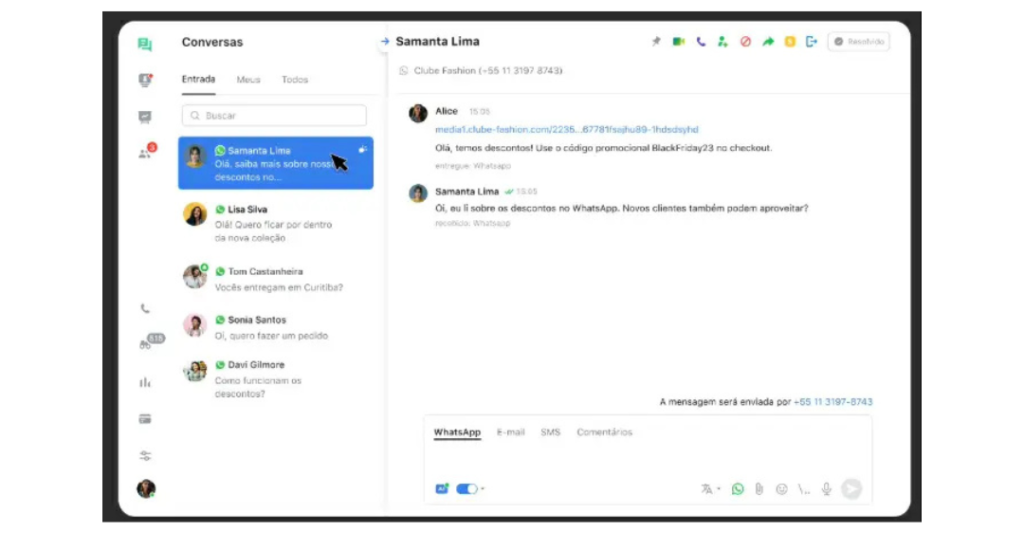
In addition, JivoChat can be integrated with WhatsApp Business, Facebook, Instagram, and Telegram. It also features an AI Agent that automates repetitive processes, significantly reducing service time and freeing up your team for higher value-added activities.
Try all of JivoChat’s features for 14 days, or use the free version with up to five operators.