

Having the best business management tools and strategies is fundamental to success in a competitive market.
The Balanced Scorecard is a methodology that has gained popularity among businesses in all sectors for offering a simple and practical strategic perspective for all types of organizations.
If you are interested in learning more about this methodology and how to apply it, check out our article.
What is a Balanced Scorecard?
The Balanced Scorecard (BSC) is a management methodology developed in 1992 by Harvard Business School professors Robert Kaplan and David Norton.
The main idea behind the methodology is to visualize all of a company’s business metrics in a balanced way, grouped into strategic objectives and with cause-and-effect relationships between them.
The concept originally emerged to show that businesses don’t need to focus solely on financial and accounting indicators to achieve success.
The methodology is simple and practical for inclusion in a company’s strategic planning.
Furthermore, it is not restrictive and can be used in conjunction with various popular management tools on the market.
How to apply the Balanced Scorecard in a company
The Balanced Scorecard uses four perspectives to evaluate an organization’s performance. Let’s examine each one.
1. Financial perspective
The main idea behind the Balanced Scorecard is not to limit yourself to financial and accounting indicators; however, it’s important to recognize their significance.
These factors are essential for a business to function, after all, money is needed to cover operating costs.
The purpose of this step is to evaluate your business’s short, medium, and long-term financial objectives.
Consider investor expectations and determine which goals need to be met to fulfill those expectations.
Here are some of the most important metrics and indicators for this evaluation:
- Return on Investment (ROI)
- Lifetime Value (LTV)
- Customer Acquisition Cost (CAC)
- Churn Rate
- Average Ticket
There are several other metrics besides those presented. It’s up to you to understand the business objectives and choose the most relevant indicators to lead you to the desired result.
2. Customer perspective
Customer relationship management and market share should be the focus of your company’s efforts.
This is important so that in the future your business will have a larger number of customers than it currently does.
Some crucial key points to monitor are:
- Customer Acquisition
- Customer Retention
- Customer Profitability
3. Perspective of internal processes
The focus of this perspective in the Balanced Scorecard is to identify the most impactful processes for your business in order to improve them.
It’s a step that seeks to improve the quality of internal processes, ensuring they are executed in the best possible way until excellence is achieved.
Some indicators to measure process quality are:
- Productivity
- Customer Service
- Compliance
- Innovation
4. Learning and growth perspective
The fourth perspective of the BSC aims to provide better learning within the company.
This stage aims to represent the knowledge and experience necessary for a company to achieve its goals.
The main points are:
- Training and Development
- Creation and Implementation of Organizational Culture
- Actions to Promote Employee Satisfaction
- Organizational Climate
3 benefits of using the Balanced Scorecard
Below are the main advantages of applying this concept to your company.
Simpler and more intuitive planning
No matter how well-planned your company is, it won’t achieve its results if others can’t understand it.
The Balanced Scorecard offers a simple and direct way to understand the key factors for your business’s growth.
Creating the strategic map makes this process even easier, offering a visual way for people to understand the organization’s goals and objectives.
Another important point is that the entire team ends up having the same vision of the company’s future from just one chart, avoiding communication problems.
Continuous improvement
Defining the strategic roadmap for the Balanced Scorecard also helps the company visualize the flow of necessary improvements.
Recording these objectives and goals is important because, as they are achieved, it will be necessary to renew the board.
This ensures that the organization’s improvement objectives do not become obsolete, offering teams a way to stay up-to-date and competitive.
Integration between indicators
The Balanced Scorecard (BSC) offers the possibility of integrating tangible and intangible indicators into a single strategy.
The methodology aims to encompass the relationship between the market, customers, and even employees and knowledge within the organization.
How to build a strategic map for the Balanced Scorecard
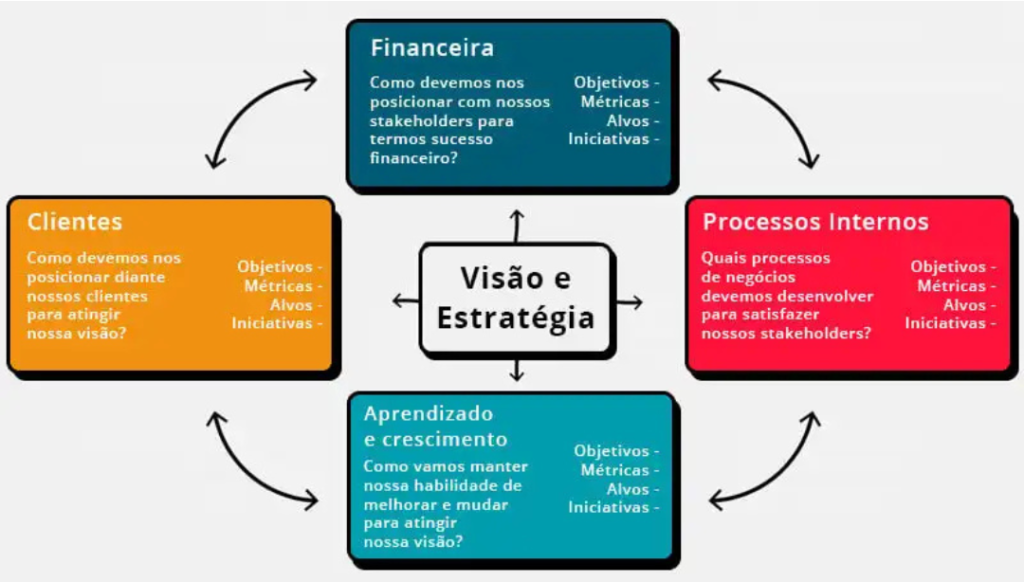
One practical way to visualize the Balanced Scorecard is to use a strategic map, similar to that used in SWOT analysis.
The idea is to create a chart with a visual summary of the concepts covered in the BSC and that will be practiced in your organization.
To do this, simply use a chart that presents the four perspectives and the elements of each one.
Some models also connect directly related factors through lines.
After defining your model, simply insert the objectives, indicators, actions, and targets related to each perspective, considering all points of view.
Below is a visual example of a strategic map for the Balanced Scorecard.
Ready to start using the Balanced Scorecard?
We hope that our article has helped you understand how this concept of strategic management works and how to apply it in your company.