

In recent years, the hybrid work model has gained significant relevance in the corporate world, allowing companies to increase productivity, reduce operational costs, and improve the quality of life of their employees.
In this article, we will explore how this work model functions, all the benefits of this format, and especially how you can implement it effectively and in a structured way within your business.
What is hybrid work?
This is a flexible work model where employees have the autonomy to choose where they want to work, whether at home, in the office, in coworking spaces, or anywhere else in the world.
This system combines elements of in-person and remote work, allowing companies and employees to adapt their routines according to their individual and collective needs.
Despite being a very flexible format, in certain situations, such as a meeting with a client or a more complex task, it will be necessary to travel to the company to work in person.
Main advantages of Hybrid Work
This work system is quite advantageous in several aspects, both for organizations and employees. Below, we have outlined some of the main benefits related to this strategy, check them out:
Employee benefits
- Flexibility: As previously highlighted, employees have complete freedom and flexibility to choose when and where to work, as long as they fulfill their responsibilities and goals.
- Work-Life Balance: By reducing commuting time, employees have more time to take care of their personal lives, which can improve their quality of life and well-being.
- Higher Level of Satisfaction: Due to the flexibility and improved quality of life, hybrid work tends to have a positive impact on employee satisfaction and engagement levels.
Benefits for companies
- Cost Reduction: Due to fewer employees working in person at the same time, the company can reduce certain expenses, such as office space rental, furniture purchases, fixed costs, etc.
- Attracting and Retaining Talent: Adopting hybrid work is an excellent way to make your company more attractive to new talent, while also decreasing turnover and increasing retention rates.
- Increased Productivity: By offering better and more flexible working conditions, your employees tend to feel happier and perform better, increasing productivity.
Explore hybrid work with Fiverr
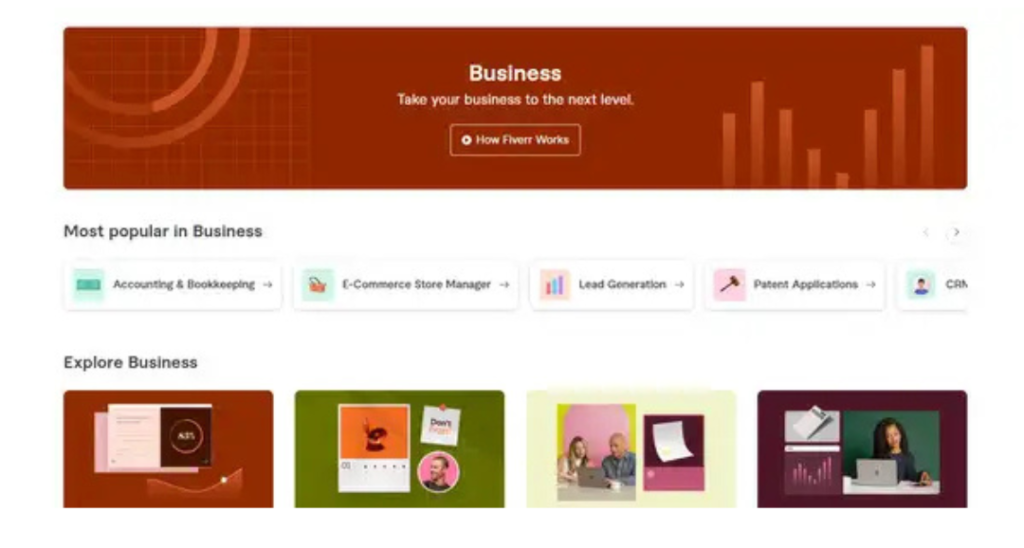
One of the advantages of hybrid work is the possibility of offering your services to clients from different parts of the world.
With Fiverr, you can find international clients and boost your business easily and quickly, without leaving home.
The platform works like a marketplace connecting workers and clients so that both can find what they need.
On it, you can register the type of service you or your company offers, provide details and descriptions, and categorize it correctly so that you can be found.
The entire negotiation process takes place within the platform, as well as the payments made there.
How to implement a hybrid work system in your company?
To implement this work model smoothly and effectively within your company, you need to evaluate and consider several factors. Here is a guide we have prepared to help you in this process:
1. Assess the Feasibility
Before beginning the transition, it’s important to determine which functions, tasks, and processes can be performed remotely and which require a physical presence, as not everything is suitable for this model.
At this stage, it’s important to schedule a meeting with your employees to understand the preferences and needs of each department. This is also an excellent way to identify who prefers to be in the office and who would like to adopt remote work.
2. Define Clear Work Policies and Guidelines
To ensure everything runs as smoothly as possible and the team is always aligned, you will need to develop clear policies and guidelines on how hybrid work will function.
This includes defining several aspects such as: which days will be remote and in-person work, how communication will be handled, and how request and approval procedures will be structured.
Together with the leaders of each team, establish performance and productivity expectations, defining goals, deadlines, and the evaluation criteria that will be used to measure results.
3. Invest in Technology
Above all, ensure that all employees have access to all the necessary tools, including laptops, software, network infrastructure, VPNs, and technical support.
In addition, adopt effective measures to facilitate communication and collaboration between teams and departments. Software such as Microsoft Teams, Slack, Google Workspace, and Zoom are excellent examples.
4. Offer Training
If it becomes necessary to adopt new tools and systems, your company will need to offer training on how to use the new programs. Take the opportunity to address topics such as digital security, time management, and communication practices.
5. Technical Support
Don’t forget to establish technical support channels to help your employees resolve issues related to malfunctioning programs and devices whenever necessary.
6. Information Security
It is essential that, together with a team specializing in information security, the company implements rigorous measures to protect sensitive and confidential data, especially when employees are working remotely.
7. Labor Laws and Regulations
Last but not least, speak with a lawyer or your company’s legal department to ensure that all practices adopted comply with labor laws and regulations.
Have you learned what hybrid work is and how to implement it in your company?
We hope our article has helped you understand how hybrid work functions, all the benefits it offers, and, most importantly, how you can implement it efficiently in your company.